Here's the honest truth from 22 years of running a print shop: there's no single "best" printing method. What works perfectly for one order is completely wrong for another. We've watched customers spend too much on the wrong process because nobody took the time to explain the differences. Let's fix that.
Traditional Screen Printing
Screen printing's been around since the Song Dynasty. Okay, that's over a thousand years of refinement. We push plastisol ink through a mesh screen, one color at a time, one screen per color. When you're printing 500 red and white company logos, nothing beats it. The ink sits on top of the fabric, stays vibrant forever, and costs pennies per shirt at volume.
When Screen Printing Makes Sense:
- You're ordering 48+ pieces (below that, setup costs kill you)
- Your design uses 1-6 solid colors
- You need that bold, punchy spot color look
- Budget matters and you're printing at volume
When It Doesn't:
- Each color adds $35-40 in screen charges. A 12-color design gets expensive fast
- Gradients and photos? Possible with simulated process, but not pretty
- Small orders don't make economic sense
- The screen setup takes time even if you're only printing 50 shirts
Hybrid Printing (What We Specialize In)
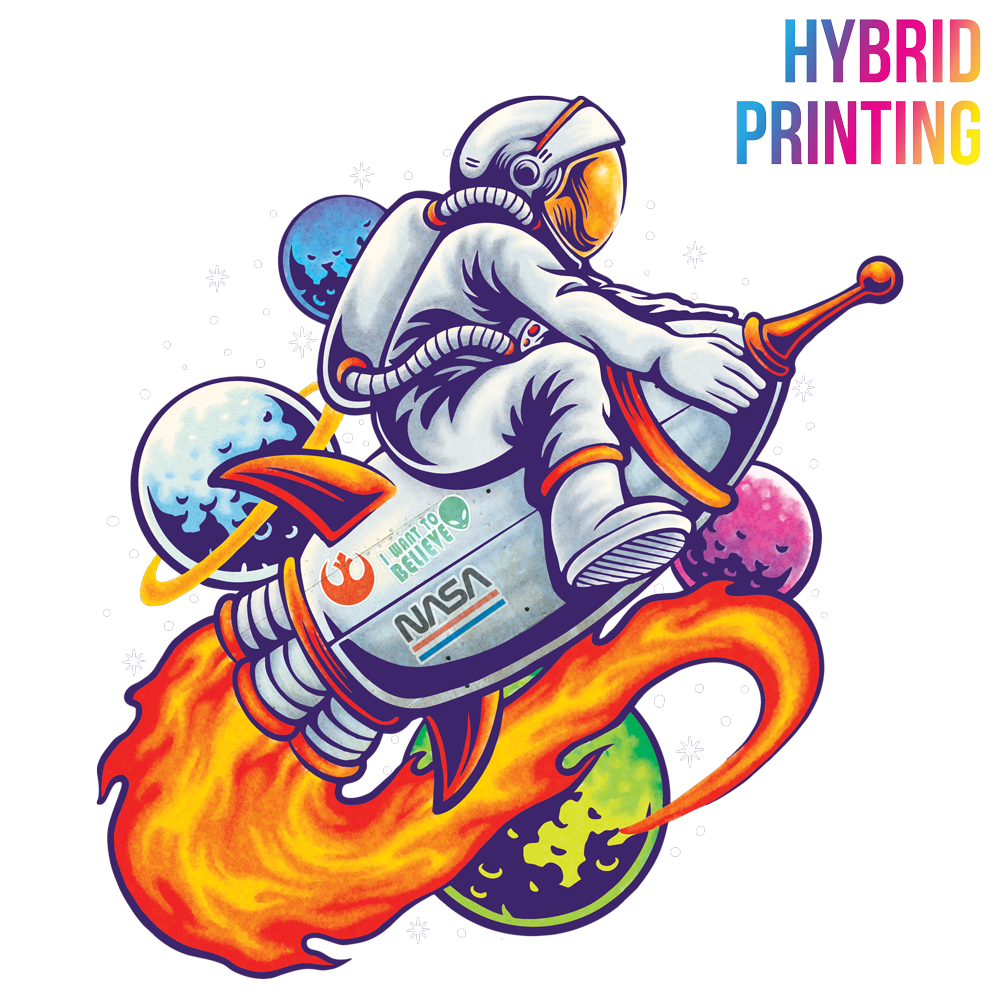
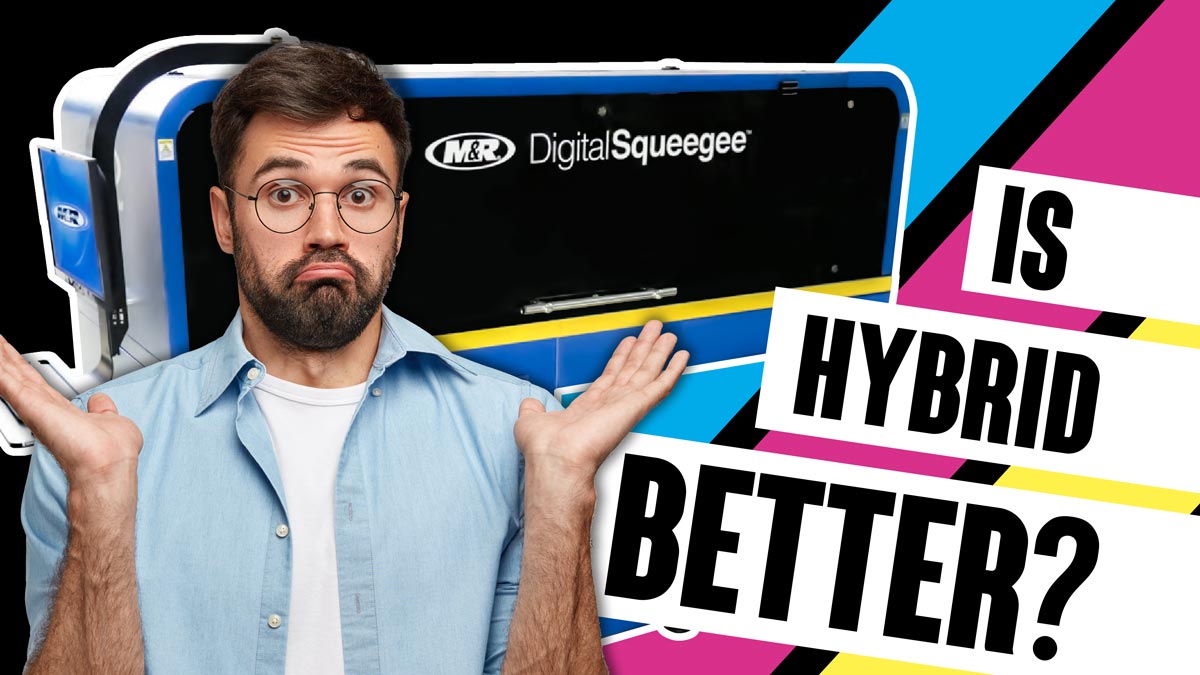
We screen print a white plastisol base, then spray CMYK digital ink on top while it's still wet. Everything cures together. You get screen printing's toughness with digital's ability to reproduce photographic detail. We've run maybe 50,000 hybrid prints at this point. Still gets us excited watching a full-color photo come off the press.
Hybrid Is Your Answer When:
- You've got 72+ pieces and a complex design
- Your artwork has gradients, photos, or unlimited colors
- You need prints that survive industrial washing. We test ours to 50+ cycles
- Consistency matters across thousands of shirts (digital doesn't drift like mixed inks)
What Makes It Different:
- Unlimited colors, same price. Two colors or two million, doesn't matter.
- 300 DPI resolution. That's five times sharper than traditional simulated process.
- Soft hand feel despite the durability. People are always surprised.
- No color variation between first shirt and last. Digital is digital.
"We've had customers send back three-year-old hybrid prints asking 'how is this still this bright?' That's the whole point."
DTF (Direct-to-Film)
DTF prints your design onto special film, applies adhesive powder, then heat-presses it onto the shirt. No screens, no setup, no minimums. You can literally order one shirt. We use DTF for samples, small orders, and anything going on polyester or performance fabrics that hybrid can't handle. Learn more on our DTF digital printing page.
DTF Works Great For:
- Small orders, even just one piece
- Rush jobs when you need it yesterday
- Full-color designs without the 72-piece minimum
- Polyester, nylon, performance gear that can't take hybrid's curing temps
The Tradeoffs:
- Per-piece cost is higher at volume (there's no economy of scale)
- You can feel the transfer layer. It's subtle, but it's there.
- We stick to standard print areas. Specialty placements get tricky
The Simple Decision Tree
After explaining this a few thousand times, here's how we think about it:
- Need 1-50 shirts? DTF. Don't overthink it.
- 500+ shirts with a simple 2-3 color logo? Traditional screen printing. Cheapest per piece.
- 72+ shirts with a complex full-color design? Hybrid. This is our wheelhouse.
- Photo or portrait that needs to look amazing? Hybrid. Nothing else comes close.
- Printing on polyester or athletic wear? DTF for small orders, sublimation for large.
- Need it to survive commercial laundering for years? Hybrid or traditional screen.
Have more questions about print methods, pricing, or turnaround times? Check out our frequently asked questions.