What Is Hybrid Printing?
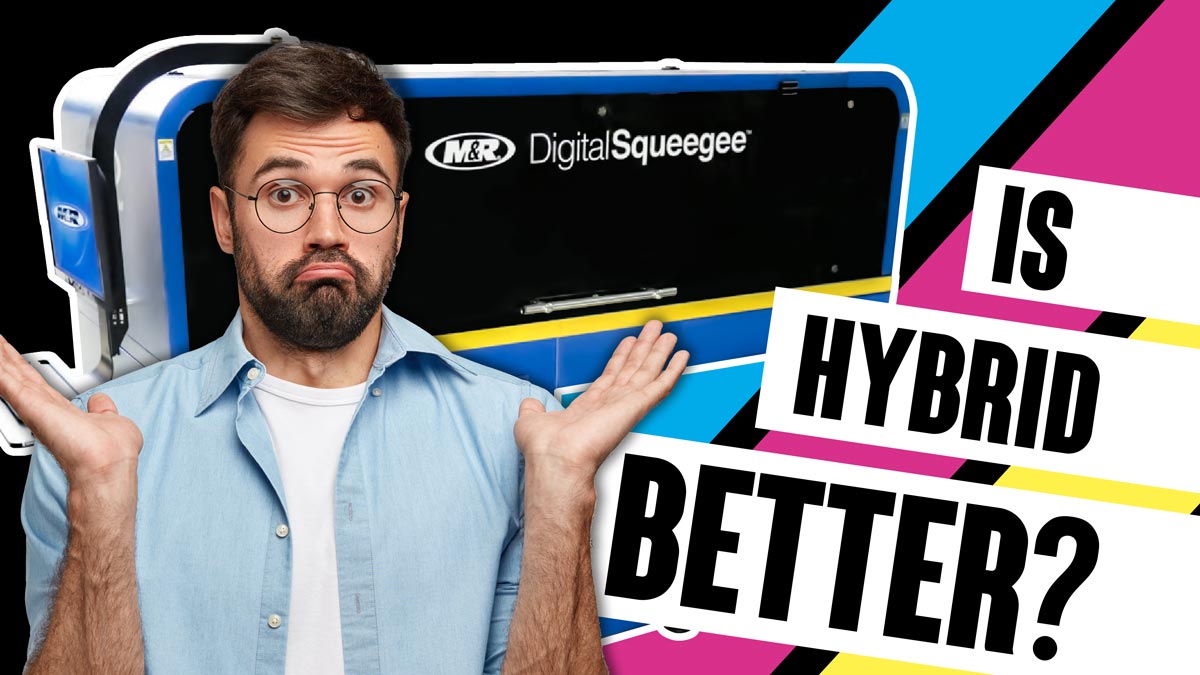
Here's the short version: we take the rock-solid durability of screen printing and marry it to the color freedom of digital. The machine that makes this possible? M&R's Digital Squeegee, a press we've run for thousands of jobs since installing our double-head setup.
Hybrid printing lays down a wet plastisol base coat, then immediately hits it with CMYK digital ink before anything cures. That wet-on-wet process is the secret sauce. The inks fuse together under heat, creating a print that's essentially bulletproof.
We're talking 300 DPI resolution. That's five times sharper than simulated process printing. Unlimited colors with zero additional screens. And prints that survive 50+ washes without cracking or peeling. After 22 years in this business, that still impresses us.
Why We Made the Switch
Look, we ran traditional screen printing for over a decade before investing in hybrid technology. We know the pain points firsthand.
Screen printing gave us incredible durability and that buttery soft hand feel customers love. But quoting a 12-color design? You're looking at $35-40 per screen, two hours of setup, and a lot of ink mixing headaches. Most jobs max out at 6-8 colors before costs spiral.
DTG seemed like the answer when it emerged: unlimited colors, print one shirt at a time. Great for samples. But we watched those prints fade after 20 washes. And forget polyester blends; DTG basically requires 100% ringspun cotton or you're asking for trouble.
DTF transfers filled some gaps. No minimums, works on anything. But there's a learning curve, and the hand feel is different. You can feel that film layer, even on the good stuff.
Hybrid gave us a third path. All the durability we trusted from plastisol, with digital's ability to reproduce photographic detail. That's not marketing talk. It's what we see on press every day.
How the Digital Squeegee Works
When customers visit our shop, this is the part that gets them excited. Watching a shirt go from blank to finished print in under 30 seconds never gets old, even after running tens of thousands of pieces through our dual-head setup.
-
Step 1: Lay the Foundation
First, we screen print a white plastisol base. Nothing fancy, just standard low-bleed white on a 156 mesh screen. On black shirts, this base coat is everything. Without it, your colors look muddy. With it, they pop like they're backlit. We dial in coverage at around 35-40 grams per square meter, though we'll adjust depending on the fabric.
-
Step 2: Hit It While It's Wet
Here's where the magic happens. That plastisol base is still gooey, uncured, tacky to the touch. The press indexes forward and 16 print heads spray CMYK ink directly onto that wet surface. We're talking 300 DPI precision. The digital ink doesn't just sit on top; it sinks into the plastisol and becomes part of it. Timing matters here. Wait too long and the base starts to gel. Rush it and you get ink pooling. Our operators have the rhythm down cold.
-
Step 3: Lock It In
The shirt rides through our conveyor dryer at 320°F for about 45 seconds. Both ink layers cure together, fusing into a single bonded print. Pull a finished shirt off the belt and try to crack that print. You can't. We've tortured test shirts with industrial washers. 50 cycles, 60 cycles, and the print just doesn't quit.
The Wet-on-Wet Difference
People ask us all the time: "Why not just print digital on top of cured plastisol?" We tried that early on. Bad idea.
When you print onto wet plastisol, the inks chemically bond during curing. There's no weak point where the layers meet, no seam that could delaminate later. The digital ink essentially inherits plastisol's toughness. And because the white base stays bright underneath, colors stay vivid even on black or navy shirts.
DTG takes the opposite approach: ink goes straight into fabric fibers. That's why DTG prints feel so soft initially. But those fibers shift, stretch, get washed. The ink fades. We've seen three-year-old hybrid prints that look better than three-month-old DTG.
What's Under the Hood
For the gear nerds: our M&R Digital Squeegee runs 16 industrial piezo print heads arranged in a staggered array. Native output is 300 DPI, sharper than most commercial fabric printing. At full tilt, we sustain around 550-600 impressions per hour. The ink system uses water-based CMYK formulated specifically for wet plastisol adhesion. And the whole thing bolts onto our existing automatic press, so we didn't have to rip out and replace our production line.
Hybrid vs DTF vs DTG vs Screen Printing
Choosing the right printing method depends on your specific needs. Here's a comprehensive comparison:
| Feature | Hybrid | DTF | DTG | Screen |
|---|---|---|---|---|
| Minimum Order | 72 pieces | 1 piece | 1 piece | 48 pieces |
| Colors | Unlimited | Unlimited | Unlimited | 1-8 typical |
| Resolution | 300 DPI | 720 DPI | 1200 DPI | 50-60 DPI |
| Durability | 50+ washes | 50+ washes | 25-50 washes | 50+ washes |
| Hand Feel | Soft | Slightly raised | Very soft | Varies |
| Fabric Types | Cotton, blends | Any fabric | Cotton only | Most fabrics |
| Production Speed | 600/hour | Medium | 20-30/hour | 500+/hour |
| Setup Cost | Low-Medium | None | None | High |
| Cost per Unit (bulk) | $$ | $$$ | $$$$ | $ |
| Best For | 72+ detailed designs | Small orders, any qty | 1-50 pieces, cotton | Simple bulk orders |
Hybrid vs DTG: Key Differences
Many people compare hybrid to DTG since both produce full-color prints. Here are the critical differences:
- Wash Durability: Hybrid prints last 50+ washes without significant fading. DTG prints can begin fading after 25-30 washes because the ink absorbs into fibers rather than bonding on top.
- Fabric Compatibility: Hybrid works on cotton, poly-blends, and some synthetics. DTG is essentially limited to 100% cotton or very high cotton blends.
- Production Speed: Hybrid can produce 600 pieces per hour; DTG typically manages 20-30 pieces per hour.
- Vibrance on Dark Shirts: Hybrid's plastisol base creates a brilliant white foundation for colors. DTG requires pretreatment on darks, which can affect hand feel and durability.
- Specialty Effects: Hybrid can incorporate metallic inks, puff printing, and other specialty effects. DTG cannot.
Hybrid vs Traditional Screen Printing: Key Differences
- Color Limitations: Traditional screen printing typically maxes out at 8-12 colors economically. Hybrid has unlimited colors at no additional cost.
- Resolution: Hybrid achieves 300 DPI; simulated process screen printing achieves 50-60 DPI. This means sharper details, readable small text, and photorealistic gradients.
- Color Consistency: In traditional printing, wet inks can mix on press causing color shifts. Hybrid's digital system delivers identical color from the first print to the last.
- Variable Data: Hybrid can easily print different names, numbers, or designs on each piece. Traditional screening requires separate setups.
When to Choose Each Method
| Scenario | Best Method | Why |
|---|---|---|
| 100+ shirts, photorealistic design | Hybrid | Best quality at scale, unlimited colors |
| 25 shirts, complex design | DTF or DTG | Below hybrid minimum, good quality |
| 500 shirts, 2-color logo | Screen | Lowest cost for simple designs at volume |
| 1 sample shirt | DTF | No minimum, any fabric |
| Athletic polyester jerseys | DTF or Sublimation | Full poly compatibility |
| Band merch, 200 pieces | Hybrid | Durable, vibrant, photo-quality art |
What Makes Hybrid Worth It
Kiss Screen Setup Fees Goodbye
This is the big one. Our old quoting formula for screen printing: base price plus $38 per color for screens, plus time for color separations. A photorealistic design with gradients? We'd have to simulate it with maybe 8-12 spot colors. That's $300-450 in screen charges before we print a single shirt.
Hybrid flipped that math. Two colors or two million colors, same setup. We quote complex artwork the same as simple logos. Customers who used to compromise their designs to save on screens? They don't have to anymore.
Detail That Actually Holds Up
We printed a batch of shirts last month with 6-point disclaimer text in the design. Readable. Sharp. Try that with a 230 mesh screen and watch it fill in after 50 impressions.
At 300 DPI, the Digital Squeegee reproduces photographic detail that traditional screens can't touch. Smooth gradients without halftone dots. Fine linework that stays crisp. Portrait prints where you can see individual eyelashes. We've run designs our art department assumed would need to be simplified, and they came out cleaner than the original file.
Built to Survive the Wash
Here's our standard test: we grab five random shirts from every major run and wash them weekly for three months. Twelve weeks. Around 50 cycles in a standard top-loader with regular detergent, medium heat dry.
Hybrid prints come back looking essentially new. No cracking along fold lines. No fading in high-abrasion areas. The plastisol base anchors everything to the fabric, and the digital ink is locked into that base permanently. We've literally tried to destroy test prints and failed.
Consistency Across 5,000 Pieces
Traditional screen printers know the drift. Inks mix on press throughout a run. By shirt 3,000, your colors have shifted from shirt 1. You're pulling samples, adjusting, hoping nobody notices the variation.
Digital doesn't drift. Shirt 1 matches shirt 5,000. Period. When a customer reorders six months later, we can match their original run exactly. Try that with spot colors mixed by eye.
Hand Feel That Surprises People
Customers expect plastisol prints to feel thick. Heavy. They touch a hybrid print and do a double-take. The base layer is thin, maybe 25-30 microns, and the water-based digital inks add almost no perceivable thickness. You get durability without the "sticker" feel some people associate with screen printing.
Cleaner Production
The digital inks we run are GOTS-certified, vegan, water-based, and free of the nasty stuff: no PVC, no phthalates, no heavy metals, no VOCs. Our press operators appreciate not working with solvent-based anything. Cleanup is literally just water. The reduced chemical handling has made our shop a better place to work, and customers increasingly ask about sustainability. We have good answers now.
Production Speed That Scales
We average around 550 impressions per hour on standard runs. Peak is north of 600 when everything's dialed in. Compare that to DTG. Even a fast machine tops out around 30 shirts an hour. When a customer needs 2,000 shirts in four days, hybrid makes that possible. DTG doesn't.
Play Nice with Specialty Effects
Want metallic accents in your design? Puff print on the logo? Glow-in-the-dark elements? Hybrid plays nice with traditional screen printing techniques because it IS screen printing, with a digital enhancement. We've done combo jobs with foil highlights, dimensional puff effects, even discharge-then-hybrid sequences. DTG can't do any of that. You're locked into CMYK-only output.
When Hybrid Isn't the Right Call
We believe in hybrid printing, obviously. But we're not going to pretend it works for everything. Here's where we steer customers toward other methods.
The 72-Piece Floor
Our minimum is 72 shirts. Period. We still burn screens for hybrid. That white base has to come from somewhere, and screen setup takes time whether we're printing 20 shirts or 2,000. Below 72 pieces, DTF or DTG makes more sense economically. We'll tell you that upfront rather than quote something ridiculous.
Cotton or Bust (Mostly)
Hybrid loves cotton. Ringspun, combed, whatever. 100% cotton is our sweet spot. High cotton blends like 80/20 or 90/10 work fine. Some 50/50 blends behave; others don't. It depends on the garment construction.
Pure polyester? Nylon? Performance fabrics? Those are a hard no. Our dryer runs around 320°F, and synthetics don't love that kind of heat. Some will scorch, others will shrink weirdly, and plastisol adhesion can be sketchy anyway. If you're printing on moisture-wicking jerseys or 100% poly athletic wear, we'll point you toward DTF or sublimation instead.
CMYK Has Limits
Digital printing lives in CMYK color space. Most colors reproduce fine, probably 95% of what customers bring us translates accurately. But CMYK can't hit certain shades: neon green, ultra-saturated orange, some specific Pantone purples and blues. If your brand guide demands PMS 802 (that radioactive green), we can add a spot color screen to nail it. Just know that adds setup time and cost.
Not Every Shop Runs This
Hybrid equipment isn't cheap. A Digital Squeegee setup runs into six figures, plus you need the press to bolt it onto. Most small shops can't justify that investment. This is technology you'll find at established production shops with volume to support it. If your local printer says they don't offer hybrid, that's probably why.
Location, Location, Location
Standard print placements (front chest, full front, full back) are straightforward. Sleeves, pockets, side panels, or all-over prints get complicated. The Digital Squeegee has a fixed print window, and garment geometry matters. We can often figure out workarounds, but some locations just work better with traditional screen printing or DTF transfers.
Where Hybrid Really Shines
After running hybrid for years, we've seen the orders that work perfectly and the ones that probably should've gone another route. Here's where we consistently see great results.
Band Merch and Tour Gear
This is probably our bread and butter. Musicians show up with album artwork featuring 47 different colors, photo collages, insane gradients, stuff that would cost a fortune in traditional screen setup. We ran a batch last year for a touring metal band: full-color front design reproducing original cover art, photorealistic back print of the band. 800 shirts in two days. Three years later they're still selling them online and the prints haven't budged.
Emerging Fashion Brands
Smaller apparel brands launching new lines often need that high-end look without massive initial orders. Hybrid lets them print detailed, gradient-heavy, photographic designs at 100-200 piece quantities without simplifying their creative vision. We've worked with streetwear labels doing complex all-over patterns and fashion startups with watercolor-style graphics. The resolution handles it.
Festival and Event Merch
When you need 3,000 shirts for a music festival and the design has a detailed lineup poster, hybrid makes sense. Speed matters, and we can knock out festival-scale orders in a couple of production days. And when those attendees wear those shirts all summer, the prints hold up.
Corporate Stuff (Yes, Really)
Corporate branding sounds boring, but consistency matters to these folks. When a company orders 500 polos across six regional offices, they want every logo to match exactly. Hybrid delivers that. No color drift between early and late runs. No variation between batches. Their brand standards people can relax.
Team Uniforms With Variable Data
Sports teams are interesting because you often need names and numbers that change per shirt. We can handle variable data, different player names on each piece, within the same hybrid run. One setup, one pass through the press, and every shirt comes out personalized. Try that with traditional screens.
Artist Collaborations and Limited Drops
When an artist creates original work specifically for an apparel collaboration, they care about reproduction quality. Hybrid preserves that integrity. We've printed limited-edition pieces where the artist approved press proofs and cried actual tears seeing their work translated to fabric exactly as they envisioned. That's the stuff that makes this job worth doing.
Questions We Hear Every Week
Okay, but what actually IS hybrid printing?
Short answer: we screen print a white plastisol base, then spray digital CMYK ink onto it while it's still wet. Everything cures together in the dryer. You get screen printing durability with digital's unlimited color capability. Our machine, the M&R Digital Squeegee, runs 300 DPI resolution. That's sharper than most commercial printing and way beyond what traditional screens can do.
What's your minimum order?
72 pieces for hybrid. We know that's higher than DTG or DTF shops, but there's a reason. We still burn a screen for that white base coat, and screen setup takes time regardless of quantity. Below 72 shirts, the math just doesn't work for hybrid. We'll typically steer smaller orders toward DTF, which has no minimum and gets you 90% of the way there quality-wise.
Will these prints actually last?
We test every major run. Five random shirts, washed weekly for 12 weeks. That's 50+ cycles. Our hybrid prints come back looking nearly identical to day one, no cracking, no peeling, no significant fade. We've pushed test shirts past 75 washes and they still held up. Compare that to DTG, where we've seen noticeable degradation after 20-25 washes on some prints.
Why not just use DTG? It seems simpler.
DTG has its place. If you need 15 shirts on 100% ringspun cotton and don't care about longevity, it's fine. But DTG ink absorbs into fibers. That's why it feels so soft. It's also why it fades. Hybrid bonds ON TOP of the fabric with a plastisol anchor. The durability difference isn't subtle. Also: DTG chokes on polyester. Hybrid handles blends just fine.
How sharp can you really print?
300 DPI native resolution. For reference, traditional simulated-process screen printing maxes out around 50-60 DPI. We've printed 6-point text that's crisp and readable. Photographic portraits with visible eyelash detail. Gradients so smooth you'd swear they were airbrushed. If your source file is high-res, we can reproduce it.
What about matching my brand's Pantone color?
Tricky question. Hybrid uses CMYK, so we're limited to that color gamut. Most Pantones convert fine. But certain colors (think neon green, super-saturated orange, some violets) live outside CMYK range. For those, we can add a spot color screen to nail the exact shade. It adds setup time and cost, but when brand consistency matters, it's worth it.
What kind of shirts work best?
100% cotton is ideal. Ringspun, combed, whatever. High cotton blends (80/20, 90/10) work great too. 50/50 poly-cotton is hit or miss. It depends on the specific garment. Pure polyester, nylon, performance fabrics? Not recommended for hybrid. The curing temperatures can damage synthetic fibers. We'll push you toward DTF or sublimation for those.
How does hybrid stack up against DTF transfers?
Different tools for different jobs. DTF has zero minimums and prints on anything, including poly and nylon. Hybrid has better durability and a softer hand feel, but needs 72+ pieces and prefers cotton. For large orders on cotton or cotton-blend tees, hybrid wins on quality and per-piece cost. For small orders or anything synthetic, DTF is your friend.
How fast can you turn orders around?
Standard is 5-7 business days from art approval. We've done rush jobs in 48 hours when schedules align. Our press runs around 550-600 shirts per hour, so even a 3,000-piece order only needs about six hours of print time. The bottleneck is usually art prep and proofing, not production.
Is this stuff actually eco-friendly or is that marketing?
Not marketing. The digital inks we run are GOTS-certified organic, vegan, and water-based. No PVC, no phthalates, no lead or heavy metals, no VOCs. We clean the print heads with water. Our press operators aren't breathing solvent fumes. Is it perfect? No. We still use plastisol for the base coat. But compared to traditional screen printing with solvent-based everything, it's a significant step forward.
Printing Terminology Glossary
- Plastisol
- PVC-based ink that sits on top of fabric fibers rather than absorbing into them. Provides excellent opacity, durability, and vibrant colors. Requires heat curing (typically 320°F/160°C).
- Digital Squeegee
- M&R's patented hybrid printing technology that prints CMYK digital ink directly onto wet plastisol base coats using 16 advanced inkjet print heads.
- DTG (Direct to Garment)
- Digital printing method where ink is sprayed directly onto fabric fibers using modified inkjet technology. Best for cotton, no minimum orders, but lower durability than hybrid.
- DTF (Direct to Film)
- Digital printing method where designs are printed onto special film, then transferred to garments using heat and adhesive powder. Works on any fabric type with no minimums.
- CMYK
- The four-color printing model using Cyan, Magenta, Yellow, and Key (Black). All full-color digital printing uses CMYK to reproduce the visible color spectrum.
- DPI (Dots Per Inch)
- Measurement of print resolution. Higher DPI means finer detail. Hybrid printing achieves 300 DPI; traditional screen printing achieves 50-60 DPI.
- Simulated Process
- Traditional screen printing technique using 8-12 spot colors printed with halftone dots to simulate full-color images. Limited by screen mesh and ink mixing.
- Hand Feel
- The tactile sensation of a print when touched. Ranges from "soft" (barely noticeable) to "heavy" (thick, plasticky). Hybrid printing achieves a soft to medium hand feel.
- Wash Durability
- How many wash cycles a print can withstand before noticeable fading, cracking, or deterioration. Hybrid prints typically last 50+ washes.
- Curing
- The heat treatment process that permanently bonds ink to fabric. Plastisol cures at approximately 320°F (160°C). Proper curing is essential for durability.
- Underbase
- A white ink layer printed first to create an opaque foundation for colors, especially on dark garments. In hybrid printing, the plastisol base serves this function.
- GOTS (Global Organic Textile Standard)
- International certification for organic textiles and processing. GOTS-certified inks meet strict environmental and toxicological criteria.
Ready to See What This Thing Can Do?
We've been printing shirts for 22 years. Watched screen printing evolve from hand-pulled squeegees to automatic presses. Saw DTG emerge and mature. Tried DTF when it showed up. Through all of it, hybrid printing remains the technology we're most excited about, because it solved problems we'd been fighting for a decade.
Our double Digital Squeegee setup handles 5,000+ hybrid prints daily. We've run rush orders, massive festival drops, and boutique limited editions. If you've got 72+ pieces with artwork you're proud of, we'd love to show you what this process can do.