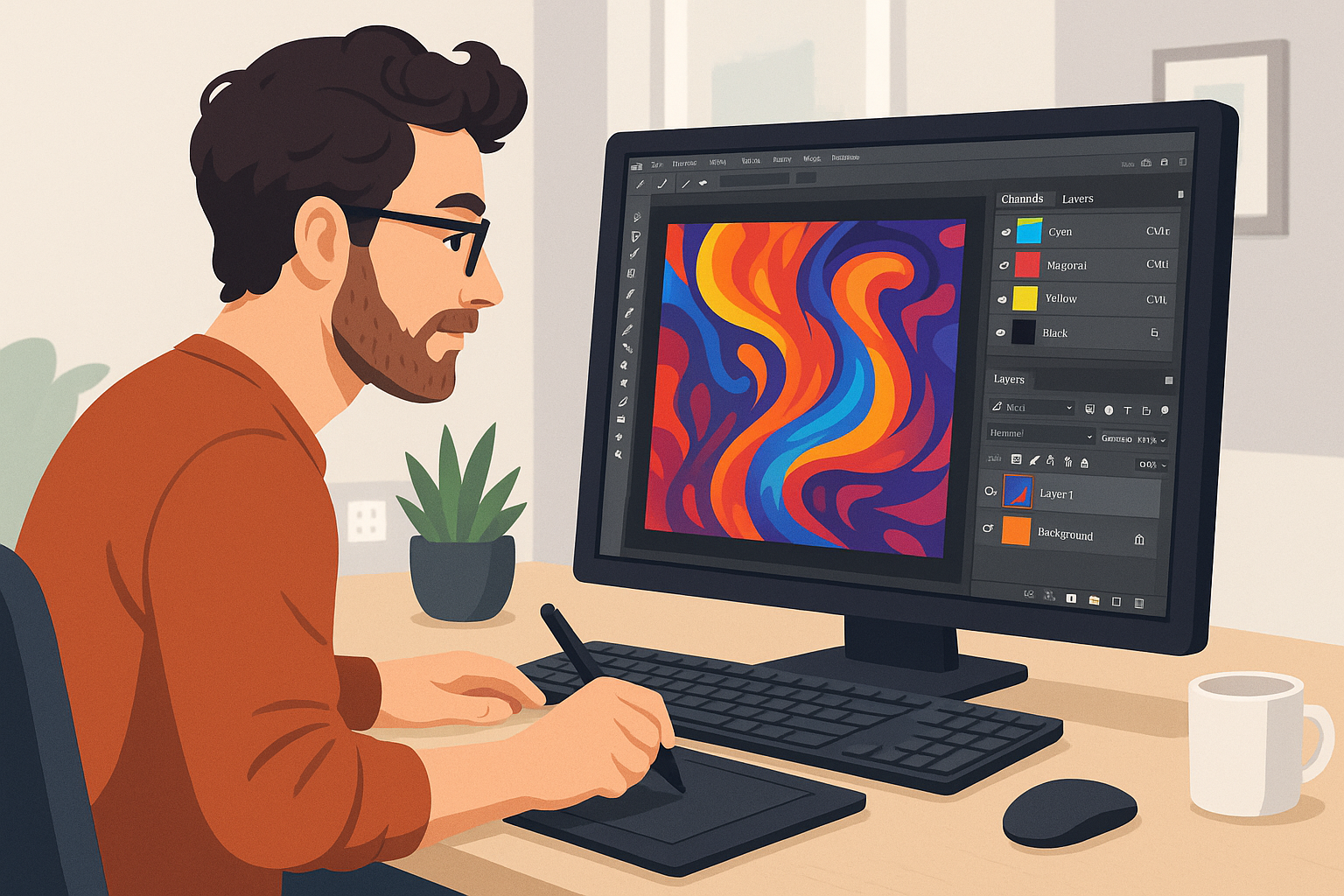
People's eyes glaze over when we start talking color separation. Fair enough. It's technical stuff. But here's why you should care: the difference between a print that pops and one that looks washed out often comes down to decisions made before ink ever touches fabric. Let us break this down in plain English.
The Old Way (And Why It Was Expensive)
Traditional screen printing means one screen per color. You want a 6-color design? That's six aluminum frames with mesh stretched over them, six different inks mixed to spec, six separate passes through the press. Each screen costs $35-40 to burn. A photographic image with gradients might require 8-12 colors in "simulated process," and even then, up close, you'd see the halftone dots.
Hybrid changed the math completely. We burn one screen, the white underbase. Then the Digital Squeegee does everything else in CMYK (Cyan, Magenta, Yellow, Black). Those four inks, layered at different densities, reproduce millions of colors. A 47-color design costs exactly the same as a 2-color design.
That White Base? It's Everything.
Don't skip this part. The screen-printed white plastisol base is the foundation of every hybrid print. We run it through a 156 mesh screen, targeting about 35-40 grams per square meter of coverage. Here's why it matters:
- Without it, colors disappear: Digital CMYK inks are translucent. Print them directly on a black shirt and you'd see almost nothing. The white base is like a projector screen. It gives colors something bright to sit on.
- Consistency across garment colors: That same design looks identical on a navy shirt, a red shirt, a charcoal shirt. The white base standardizes everything.
- This is what makes it durable: Plastisol bonds with fabric fibers. The digital ink bonds with the plastisol. After curing at 320°F, you've got layers that are essentially fused together. We wash-test our prints to 50+ cycles. They hold.
- Hand feel depends on getting it right: Too thick and the print feels heavy. Too thin and colors look dull. Our press operators have the touch dialed after thousands of runs.
CMYK: Four Colors, Infinite Possibilities
Once that white base is down (still wet, timing matters), our 16 print heads spray CMYK ink at 300 DPI resolution. Cyan plus yellow makes green. Magenta plus yellow makes orange. Layer all four at different percentages and you've got skin tones, sunset gradients, photographic detail. It's the same principle as your inkjet printer, except designed for fabric and scaled for production speed.
"A customer once asked how we print 'all those different greens' in a landscape design. Answer: we don't. We print cyan and yellow in varying amounts and your eye does the rest. That's CMYK."
What You Should Know About Color Accuracy
CMYK is amazing, but it's not magic. A few things to keep in mind:
- Your screen lies to you: Monitors display RGB. Printers use CMYK. Some colors just don't translate perfectly, especially super-saturated blues and greens.
- Neon doesn't exist in CMYK: That radioactive green in your design? We'll get close, but CMYK physically cannot reproduce it. If you absolutely need PMS 802, we can add a spot color screen. Extra setup, extra cost, but sometimes worth it.
- Pantone matching is close, not exact: We match probably 95% of Pantone colors within acceptable tolerance. The tricky 5%? We'll show you a test print first.
We'll Handle the Technical Stuff
You don't need to understand color profiles and ink densities. That's our job. Send us your design, tell us what you're going for, and our production team will figure out how to make it happen. After 22 years and tens of thousands of jobs, there aren't many situations we haven't seen. Want to learn more about how hybrid printing delivers superior results? Read about the power of the Digital Squeegee.
For technical questions about file formats, Pantone matching, or print specifications, visit our FAQ page.