We've seen it all. Customers who send us 72-pixel Instagram screenshots expecting print-ready files. Designers who create stunning work in RGB and can't figure out why the printed colors look "wrong." And honestly? We've also seen first-time customers send better-prepared files than some graphic design agencies. Here's what separates the smooth orders from the ones that need three rounds of revisions.
Send Us Something We Can Actually Print
Vector files (AI, EPS, PDF with outlined fonts) are the gold standard. They scale infinitely. We could print your logo on a building or a business card from the same file. If you work with a designer, ask for vectors. Always.
Using photos or digital paintings? That's fine. Hybrid handles raster images beautifully. But here's the rule: 300 DPI at print size. Not 300 DPI at thumbnail size, then stretched to fit a shirt. If your design will print at 12 inches wide, we need that file at 12 inches wide at 300 DPI. That's 3,600 pixels. Anything less and you'll see pixelation. We can't magically add detail that isn't there.
Quick test: zoom to 100% on your screen. If it looks blurry, it'll print blurry. If it looks sharp, we're probably good.
Colors: What Your Monitor Won't Tell You
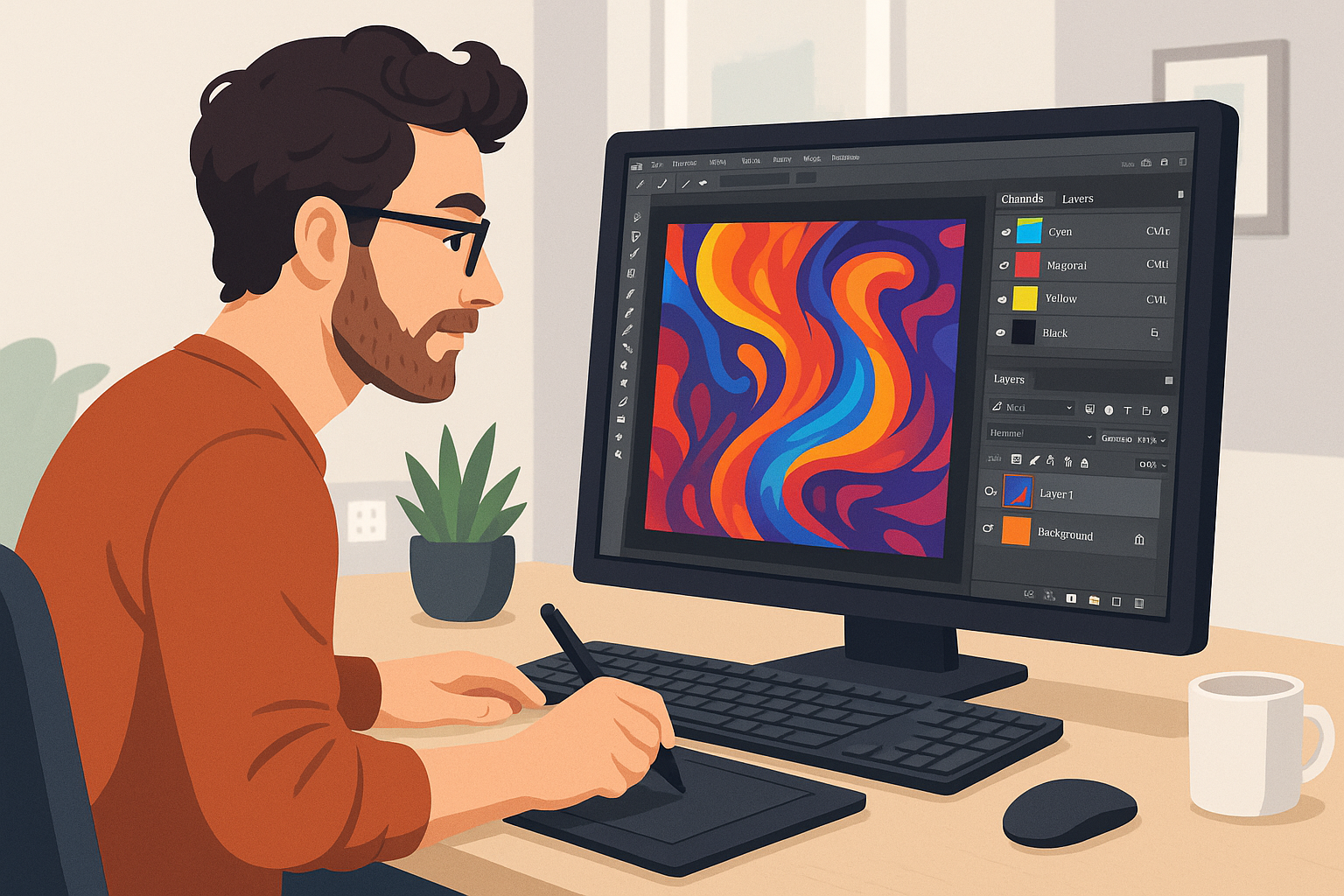
Your screen displays RGB (Red, Green, Blue). Printers use CMYK (Cyan, Magenta, Yellow, Black). These color spaces don't perfectly overlap. That electric blue on your screen? Might come out slightly muted. The neon green? CMYK physically can't reproduce it.
- Convert to CMYK before sending: At least you'll see a more accurate preview of what's possible.
- Don't panic about garment color: Our white underbase means your design looks consistent whether it's going on black, navy, or heather gray. That's the whole point of hybrid.
- Gradients are our friend: Traditional screen printing struggles with smooth color transitions. We don't. Sunset gradients, watercolor effects, soft shadows. Go wild.
Think About Where It's Going
T-shirts aren't flat. They drape over shoulders, stretch across chests, fold in armpits. A design that looks amazing on screen might disappear in the creases when someone actually wears it. We've been doing this long enough to know what works.
"Had a customer send a detailed landscape design that was stunning on paper. On the shirt? Critical details got lost in the fold below the chest. We caught it in proofing and suggested moving things around. That's what experience buys you."
Placement Options (And What Works Best)
You don't have to fill every inch of available space. Sometimes restraint is the move. Here's what we typically see work well:
- Left chest: 3-4 inches wide. Professional, subtle, works for corporate stuff and streetwear alike.
- Full front: Maximum impact. Band tees, event shirts, anything meant to be seen from across the room.
- Full back: Great for detailed artwork. People behind you at concerts will appreciate it.
- Sleeves: Underused and interesting. We can do it. Just takes some planning.
Not Sure? Just Ask.
Send us what you've got. Our art department reviews every file before quoting anyway. If something needs work, we'll tell you, and if you want us to fix it, design services start at $50. No judgment. Half our customers aren't designers, and that's fine. You know what you want; we know how to make it printable.
For a comprehensive deep-dive into everything hybrid printing can do, read our complete guide to hybrid printing. Have questions about file formats, turnaround times, or pricing? Check our FAQ.